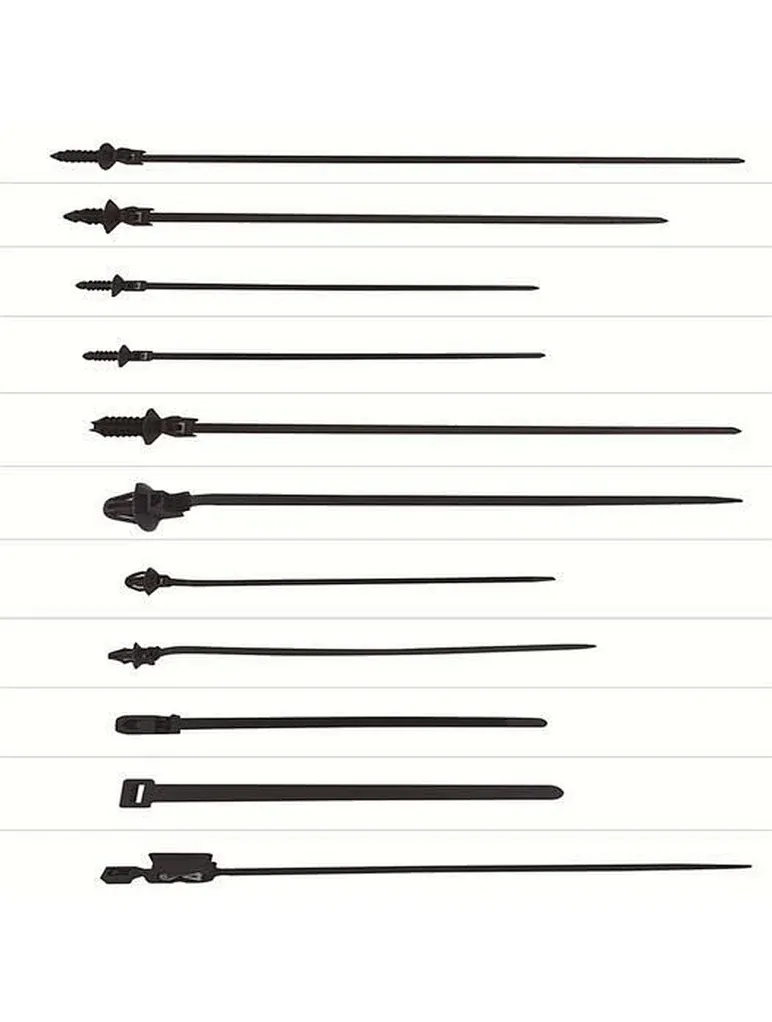
A modern vehicle carries more than 1,500 electrical connection points and 30–50 kg of wiring harness, and every one of those harnesses is held, routed and protected with parts that cost cents: cable ties, clips, conduit and sleeving. That is exactly why automotive buyers treat them as controlled components rather than consumables. This guide explains what IATF 16949 and PPAP actually ask of a harness-component supplier, what evidence a serious buyer should request, and why reel-fed supply matters more than unit price once a line is running.
Why Harness Components Are Treated as Quality-Critical
The instinct to source cable ties and clips as commodity hardware is understandable — they are a rounding error on the bill of materials. The history of warranty claims says otherwise. Across a vehicle platform, harness fixings live with:
- Continuous vibration from road input and powertrain, at frequencies and amplitudes that work any marginal joint loose.
- Thermal cycling from ambient to engine-bay and under-hood temperatures, with different expansion rates in plastic, metal and insulation.
- Mechanical stress during installation, routing and service, including pull-through forces at the tie head and clamp.
- Sustained load on the tie for the life of the vehicle, at a fraction of the loop tensile strength but for fifteen years.
The failure mode is rarely a tie that snaps in service. It is a tie that holds slightly differently from one batch to the next, so that installation force, harness position and retention vary between shifts — and variation is what produces the intermittent fault that is hardest to diagnose and most expensive to contain. That is the entire reason automotive quality systems exist, and it is why a cable tie supplier's process discipline matters more than its catalogue.
What IATF 16949 Changes for a Component Buyer
IATF 16949 is the automotive quality management standard, built on ISO 9001 with automotive-specific additions. Every mainstream OEM requires it of tier-one and tier-two suppliers, and its practical effect on a purchasing decision is that the supplier's production behaviour must be system-driven rather than run-dependent. In concrete terms:
| Dimension | General industrial supplier | IATF 16949-aligned supplier |
|---|---|---|
| Batch consistency | Meets drawing on sampled lots | Process parameters monitored within defined limits; dimensional and locking behaviour stable across batches and shifts |
| Traceability | Lot number on request | Production batch traceable to raw material input and process conditions; enables rapid containment |
| Change control | Supplier decides when to notify | Material, tooling and process changes documented, validated and communicated before shipment |
| Deviation handling | Case-by-case | Defined process for production deviations, with customer approval where design intent is affected |
| Tooling and process control | Inspection at the end of the line | Injection moulding discipline: locking-mechanism geometry is a controlled characteristic, not an outcome |
| Ongoing validation | Initial approval only | Process validation continuing beyond initial part approval |
For a buying team, the useful way to read a certificate is as a filter, not a guarantee. It tells you the system exists. It does not tell you whether this supplier's controls are mature for your specific product family — a certified plant can still be weak on high-cavity moulds, colour-masterbatch consistency or reel-fed packing if those processes are not genuinely under control. Filter with the certificate, then verify with the records.
PPAP: What the Package Should Contain
The Production Part Approval Process is the standardised route by which a supplier demonstrates that it can manufacture the part to the released design, with the process it intends to use in series production. Level 3 is the most common submission level; higher-risk programmes may require more. The core elements, and what they mean for harness components specifically:
| Element | Purpose | What to look for on a harness component |
|---|---|---|
| Design record | The released drawing and specification | Drawing revision matched to your part number, including colour, UV stabilisation and any customer-specified compound |
| PFMEA | Risk analysis of the process | Short shots, weld-line weakness at the tie head, serration geometry variation, masterbatch inconsistency, packing count errors — and the actions taken against them |
| Control plan | The controls that address the PFMEA risks | Real checks with frequency and reaction plans, not a template. If the plan says "visual inspection" with no reaction plan, the risk analysis never reached the shop floor |
| MSA | Measurement system analysis | Gauge and fixture validation for the dimensions that matter — tie head geometry, loop tensile test rig, colour verification |
| SPC / capability | Evidence the process is capable | Capability data on critical characteristics, commonly to Cpk ≥ 1.33 |
| Dimensional results | Full measurement of the released part | Not just length and width — tie head, strap width, serration pitch and locking pawl engagement |
| Material and component certificates | Prevents hidden substitution after approval | Compound data sheet for PA66, UV-stabilisation grade, and RoHS/REACH declarations where required |
| Performance test records | Confirms the design intent | Loop tensile strength, temperature performance, and any customer-specific environmental validation |
| PSW and samples | Ties the submitted data to the released part | Sample identification that traces to the exact production lot and test records in the package |
The failure patterns are consistent. Revision mismatch across the drawing, control plan and test reports. Traceability that does not connect samples to lot codes and certificates. A control plan copied from another programme. Validation run on hand-built samples rather than the defined production process. And missing reaction plans — the control plan says what is checked but not what the operator does when a result drifts. Any of these means the package does not yet demonstrate series capability, whatever the certificate says.
Resubmission Triggers Most Suppliers Miss
PPAP approval covers the part, the process, the location and the materials that were submitted. It is not a permanent waiver, and the resubmission triggers are where a well-run programme and a risky one separate:
| Trigger | Why it invalidates the approval |
|---|---|
| Drawing or specification revision | The approved part no longer matches the released design |
| Material substitution — compound, masterbatch, UV grade | Material behaviour under heat, UV and load is a design characteristic, not a purchasing decision |
| Tooling repair, replacement or new cavity | Locking geometry depends on tool condition; a repaired mould is not the validated process |
| Process parameter or machine change | Cooling time and injection profile determine shrinkage and serration form |
| Manufacturing location transfer | Different plant means different equipment, environment and operators |
| Sub-tier supplier change for the resin | Resin lot variation is the most common hidden cause of performance drift |
| Extended shutdown then restart | Mould condition and material drying state are not guaranteed after a long stop |
| Repeated field failures or escapes | The approved process is demonstrably no longer valid |
The "form-fit-function equivalent" argument deserves specific scepticism. A drop-in equivalent tie can change loop tensile, head height, strap flexibility and insertion force while looking identical — and each of those changes moves the assembly process window. If a change affects risk, process or validation, it belongs in a resubmission.
Specifying the Components Themselves
Once the quality system is satisfied, the engineering selection still has to be right. For harness work, a few decisions cover most of the range:
| Requirement | Answer | Product |
|---|---|---|
| Under-hood and high-temperature zones | PA66 with heat stabilisation; PA46 where continuous temperature exceeds the PA66 window | Heat-stabilised ties, PA46 extra heat-stabilised ties |
| Cold-climate and cold-chain exposure | Impact-modified grades that do not embrittle at low temperature | Cold-weather cable ties |
| Low-profile routing through grommets and tight gaps | Low-profile head, flush cut | Low-profile cable ties |
| Fixing to a panel or stud without a separate mount | Mountable-head and push-mount designs | Mountable-head cable ties |
| Circuit identification during assembly and service | Marker ties and colour-coded markers | Marker ties, cable markers |
| Bundling before the harness enters the loom | Spiral wrap and conduit for abrasion protection | Spiral wrapping bands, flexible conduits |
| Rigid retention at high load or temperature | Coated stainless steel ties | Steel barb nylon ties |
| Clamping at defined cable diameters | R-type clamps sized to cable OD | R-type cable clamps |
Material choice should be written into the drawing, not left to the supplier's standard offering. A "black cable tie" on a drawing is not a specification: black generally indicates a UV-stabilised compound, but the stabilisation package, the colour masterbatch and the base resin grade are all variables that affect long-term performance. Name the compound family and the temperature class, and let the certificate confirm it.
For the wire side of the harness, crimp quality is the equivalent high-risk process — described in detail in our terminals and cable lugs selection guide.
Why Reel-Fed Supply Matters More Than Unit Price
On a harness line assembling hundreds of harnesses per shift, the tie is not consumed by hand. It is fed by an automated tensioning tool or a semi-automatic dispenser, and that changes the purchase requirement in three ways:
- Packing format becomes a process input. A reel that feeds badly causes misfeeds, tool jams and line stoppages; the cost of one stoppage outweighs the annual difference in tie price. Reel core diameter, winding tension and strap alignment have to be consistent, not merely reasonable.
- Dimensional consistency becomes a yield issue. Automated tools tension to a set value. If strap thickness or head geometry varies between batches, the tool either under-tensions or breaks ties, and the breakage shows up as scrap and rework rather than as a defective part.
- Batch identity must survive to the line. When traceability matters, the reel label has to connect the ties in the operator's hand to the production lot and the material certificates. Reels with lost or ambiguous labels break the traceability chain at the exact point where it is needed.
Our reel-fed cable ties and the broader automotive cable tie series are supplied in the packing formats automated harness lines require, with the batch and material documentation that automotive programmes ask for. Where a harness design needs a non-standard head, strap length or mounting feature, custom automotive ties and clips are tooled to the application rather than adapted from a catalogue part. The automotive components range collects the full set.
Ten Questions to Ask a Harness-Component Supplier
- Which IATF 16949 site will manufacture our part, and is it the site on the certificate?
- Can you show traceability from a finished reel back to the resin lot and moulding parameters?
- What are your control limits on the characteristics that matter — head geometry, strap width, loop tensile?
- What is the reaction plan when a process parameter drifts, and who authorises a deviation?
- How do you notify us of a material, tooling or process change, and before or after shipment?
- Which sub-tier supplies your PA66 compound, and what is your incoming inspection regime for it?
- Is your PPAP package tied to a specific lot, and can we see a completed example for a comparable part?
- What packing format do you supply for automated feeding, and what are the reel and winding tolerances?
- Do you hold RoHS and REACH declarations for all compounds and colourants used?
- What is your containment process if a defect escapes to our line, and how fast can you bound the affected lots?
Sourcing Automotive Harness Components
Yueqing Huihua Electronic manufactures cable ties, clips, conduit, sleeving and wiring accessories for automotive and industrial harness programmes, operating under ISO 9001, ISO 14001, ISO 45001 and IATF 16949 management systems — documented on our certifications page. We supply reel-fed and bulk formats for automated assembly, support PPAP documentation for automotive programmes, and can OEM or private-label to your drawing through our custom programme. Send us your harness component list with annual volumes, temperature zones and packing requirements, and we will confirm specifications, provide samples for validation, and quote against the documentation level your programme requires.