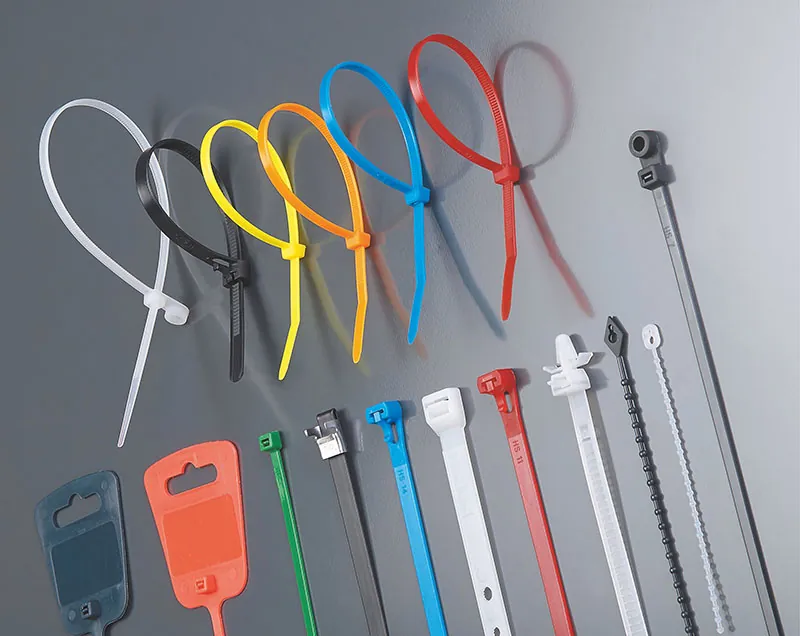
"Cable tie" is a single word for at least a dozen different products. A 4-inch natural nylon tie from a hardware store and a 316 stainless steel ball-lock tie used on an offshore platform share a name and almost nothing else — different materials, different locking mechanisms, different failure modes, and a price difference of up to 100×. This guide walks through the twelve designs that cover virtually every industrial requirement, what each one is actually for, and how to pick between them without over-specifying.
Why the Type Matters More Than the Price
A cable tie is a single-use fastener that has to hold a defined load, in a defined environment, for a defined service life. Choose too light and the bundle works loose under vibration; choose too heavy and you pay steel prices for an indoor panel job. The type — which is really a combination of material, locking mechanism, and head design — is what decides whether the tie survives. Everything else is packaging.
Below are the twelve types buyers ask about most, in roughly the order of how often they are specified.
1. Standard Self-Locking Cable Ties (PA66)
The baseline product: a nylon 6.6 strap with a pawl-and-ratchet head that locks in one direction and cannot be released. Operating range is typically −40°C to +85°C, tensile strength from 8 kg (miniature) to 55 kg and beyond (heavy duty), and they are the correct default for indoor wire bundling, control panels, appliance harnessing, and general electrical work.
Natural (white) nylon is the cheapest option. It contains no UV stabilizer, so it will embrittle and crack within months under direct sunlight — a detail that causes a large share of field failures on outdoor installations.
2. UV-Resistant / Weather-Resistant Ties
Identical geometry to the standard tie, but the nylon is compounded with carbon black. That single additive is what allows a tie to survive years of outdoor exposure instead of one summer. Black weather-resistant ties are the correct specification for rooftop conduit, telecommunications cabinets, masts, fencing, signage, and any exterior run.
Practical rule: if it sees the sun, it must be black. A natural tie used outdoors is not a cheaper option, it is a scheduled failure.
3. Heat-Stabilized Ties
Standard PA66 softens and loses loop strength above +85°C continuous. Heat-stabilized grades use a modified polymer that holds its mechanical properties to +105°C continuous (with short-term excursions higher), and PA46 grades push the ceiling to +150°C continuous / +195°C short-term.
Typical applications: near motors, transformers, LED drivers, engine compartments, ballasts, and industrial ovens. Heat stabilization and UV stabilization are separate properties — an outdoor high-temperature application usually needs both.
4. Flame-Retardant (UL94 V-0) Ties
Flame-retardant ties are formulated to self-extinguish rather than propagate flame, and are certified to UL94 V-0. They are required inside appliances, public-transport interiors, control cabinets, and any enclosure where an internal fault must not spread. Note the distinction: a V-0 tie resists ignition spread; it does not survive a fire the way steel does.
5. Stainless Steel Ties
Made from 304 or 316 stainless steel, these are the only sensible choice where the plastic ceiling is exceeded: furnaces, kilns, exhaust systems, fire-rated cable trays, marine and offshore installations, chemical plants, and mining. Uncoated steel ties hold strength well above +500°C, carry tensile loads up to several hundred kilograms, and are non-flammable. The trade-offs are cost, weight, electrical conductivity, and cut ends that can damage soft cable jackets if not dressed.
6. Coated Steel-Barb Ties (the hybrid)
A stainless steel barb and locking mechanism, over-moulded with nylon. The result combines steel's grip strength and heat resistance with a coating that protects cable insulation and adds a degree of electrical insulation. This is the standard choice for automotive underhood harnessing, heavy machinery, and any high-vibration application where bare steel would saw into the jacket.
7. Releasable / Reusable Ties
A small tab or trigger lifts the pawl so the tie can be opened and re-used. Tensile ratings are lower than single-use ties, which is the point — they are for staging, prototyping, temporary cable dressing, and anywhere the bundle will be re-entered. Coloured variants are commonly used for colour-coded bundling.
8. Beaded and Knot Ties
Beaded ties have a chain of beads along the strap and a looped head, so the bundle can be adjusted to any bead position and released by hand — no cutting tool needed. Very common for retail packaging, plant ties in horticulture, and light household cable management where adjustment is frequent.
9. Low-Profile and Outside-Serrated Ties
Standard ties have a raised head and teeth on the inside face. Two variations change that geometry:
- Low-profile head ties — a flat, rounded head that does not snag. Used on medical equipment, playground and furniture applications, and anywhere skin or clothing may contact the tie.
- Outside-serrated ties — the teeth face outward so the smooth inner face sits against the cable, reducing abrasion on soft insulation, hoses, and fibre. This is the correct choice where the tie is cinched onto elastomer or thin-wall cable.
10. Mountable-Head Ties
These integrate the tie with a fixing, eliminating a separate mount and halving installation time:
| Variant | Fixing method | Typical use |
|---|---|---|
| Push-mount / fir-tree | Snaps into a pre-drilled hole | Panels, chassis, appliance frames, automotive body |
| Screw-mount | Fixed with a screw or bolt | Machine frames, cabinets, walls |
| Saddle / tie mount | Adhesive base or screw-down saddle | Routing along surfaces, low-vibration runs |
| Wire saddle | Adhesive or screw, holds cable without crushing | Data and coaxial cable, control panels |
11. Marker and Identification Ties
A flat flag at the head accepts written or printed identification, so the bundle is labelled and secured in one operation. Standard for network cabling, wiring harnesses, and any system where a technician has to trace a circuit later. Separate cable markers are used where the label must outlive the tie.
12. Metal-Detectable Ties
Nylon or polypropylene compounded with metal particles so that even a small fragment is detectable by inline metal detectors and, in some grades, X-ray systems. This is a food-safety and pharmaceutical product, not a strength product: it exists so that a broken tie fragment cannot reach a consumer. Used with HACCP foreign-object control programmes on food production and packaging lines.
Specialty Designs Worth Knowing
- Double-head / double-loop ties — two locking heads on one strap, for securing a second parallel run without a second tie.
- Reel-fed ties — supplied on reels for automatic tensioning tools on high-volume harness lines; the fastest option at scale.
- Cold-weather ties — retain flexibility below −40°C where standard nylon embrittles. Cold-chain, refrigeration, and winter outdoor work.
- Security seals and handcuff ties — tamper-evident, single-release designs for sealing and restraint applications.
- Fixing ties for round holes — combine a snap-in base with a tie, for blind-hole mounting in sheet metal.
How to Read a Cable Tie Specification
Whichever type you choose, four numbers decide whether it fits:
| Spec | What it means | Watch out for |
|---|---|---|
| Width / size class | Miniature, standard, heavy duty — drives tensile class | Width is the headline, but head size governs fit in tight spaces |
| Tensile strength (loop) | Load at which the locked loop fails | Specify at least 2× the static load to absorb vibration |
| Bundle diameter range | Min–max diameter the length can enclose | Confirm the real bundle, not the cable nominal OD |
| Temperature range | Continuous operating limits, not survival limits | Continuous and short-term ratings are different numbers |
Choosing in Three Questions
- What will it be exposed to? Indoors → standard nylon. Sunlight → black UV-stabilized. Continuous heat above +85°C → heat-stabilized or PA46. Fire or above +150°C → stainless steel. Chemicals, salt or washdown → 316 steel or a fluoropolymer.
- How heavy is the bundle? Size the tensile rating to at least double the working load, then confirm the bundle diameter range covers your harness.
- Will it be opened again? Permanently → self-locking or steel. Re-entered regularly → releasable or beaded. Labelled → marker ties. Food line → metal-detectable.
If the answers point to several types — which is normal on a real machine — do not standardize on the worst case for the whole build. Spec per zone and keep two or three families on the approved list.
Where to Start
Our cable tie range covers all twelve types above, including standard self-locking, heat-stabilized, flame-retardant V-0, cold-weather, metal-detectable, low-profile, releasable, stainless steel and coated steel-barb series. Our nylon ties are certified to UL 62275 (File E220676, Type 21).
Send us the application — environment, bundle size, quantity — and we will confirm the correct type and send samples. If you are still narrowing down materials, read our guide to cable tie materials next.