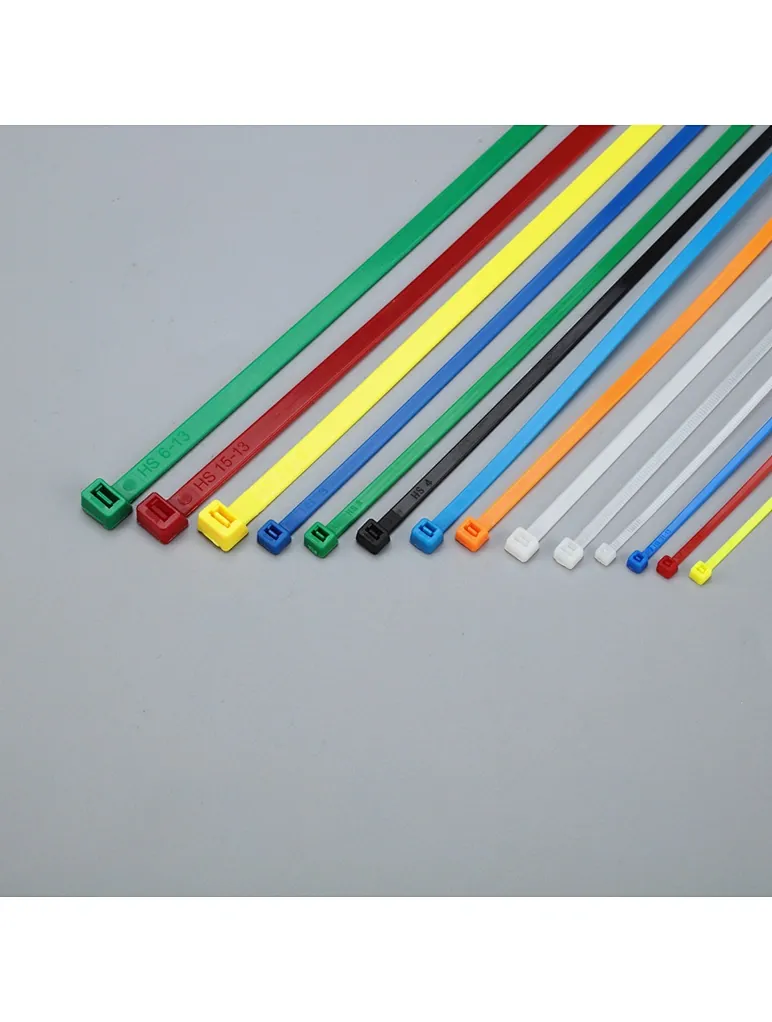
Two cable ties can look identical, carry the same dimensions, and behave completely differently in service — because the material, not the shape, decides the outcome. A PA66 tie fails at +90°C; a PA46 tie holds at +150°C. A natural nylon tie embrittles in one summer outdoors; a carbon-black tie lasts years. An ETFE tie costs eight times more and is worth every cent inside a chemical plant. This guide compares the materials actually used in industrial cable ties, what each one is for, and how the additives change performance without changing the polymer name.
The Material Selection Table
These are the properties that decide a specification. Continuous operating temperature is the number that matters — short-term excursion ratings are always higher and are often quoted misleadingly.
| Material | Continuous temp. | Flammability | Moisture absorption | Chemical resistance | Relative cost |
|---|---|---|---|---|---|
| PA6 (nylon 6) | −40°C to +80°C | UL94 V-2 | High (2–3%) | Fair | 1× |
| PA66 (nylon 6.6) | −40°C to +85°C | UL94 V-2 | High (1.3–2.5%) | Good vs oils; poor vs acids | 1× (reference) |
| PA66 heat-stabilized | −40°C to +105°C | UL94 V-2 | High | Good vs oils | 1.1–1.3× |
| PA66 heat + UV stabilized | −40°C to +105°C | UL94 V-2 | High | Good vs oils | 1.2–1.4× |
| PA46 | −40°C to +150°C | UL94 V-2 | Very high | Good vs oils | 3–5× |
| PA12 / PA11 | −40°C to +85°C | UL94 HB | Very low (0.25%) | Good vs acids, bases, fuels | 2–3× |
| PP (polypropylene) | −20°C to +80/110°C | UL94 HB | <0.1% | Excellent vs acids and salts | 1.0–1.5× |
| POM (acetal) | −40°C to +90°C | UL94 HB | Low | Fair | 1.5× |
| PVDF | −40°C to +150°C | UL94 V-0 | <0.04% | Near-universal vs acids and solvents | 5–8× |
| ETFE (Tefzel-type) | −70°C to +170°C | UL94 V-0 | <0.03% | Best available; resists chlorinated solvents | 8–12× |
| Stainless steel 304 | to +538°C | Non-flammable | None | Good; pitting risk in chlorides | 5–20× |
| Stainless steel 316 / 316L | to +538°C | Non-flammable | None | Excellent vs chlorides and salt spray | 5–25× |
Polyamide 6.6 — The Default, and Its Two Limits
PA66 is the material behind the overwhelming majority of cable ties sold worldwide, and for good reason: high yield strength, good impact resistance, low friction, and low cost. Its two limits define every conversation about cable tie selection:
- Heat. Continuous service stops at +85°C. Above that the polymer softens progressively and the loop loses clamping force long before it visually fails. If your application runs at +90°C to +105°C, you need the heat-stabilized grade; above +105°C, PA46.
- UV. Unstabilized nylon degrades in sunlight — the surface chalks, then micro-cracks, then the tie snaps at the head under load. This is why every credible outdoor tie is black.
One further caution: PA66 absorbs up to 2.5% moisture by weight. In hot, humid or continuously wet service this drives hydrolytic degradation, which is why nylon ties are a poor choice for constant-immersion or steam environments regardless of their temperature rating.
Additives: The Same Polymer, Three Different Products
Most "new materials" in a cable tie catalogue are the same base polymer with different additives. Knowing which additive does what prevents both over- and under-specification:
| Additive | Property it delivers | Typical grade name |
|---|---|---|
| Carbon black | UV / weathering resistance | Weather-resistant / UV black |
| Heat stabilizer | +105°C continuous service | Heat-stabilized |
| Halogen-free flame retardant | UL94 V-0 self-extinguishing | Flame-retardant / V-0 |
| Metal pigment | Detectability by metal detector / X-ray | Metal-detectable |
| Glass fibre | Higher stiffness and temperature (+105°C) | PA66-GF |
| Impact modifier | Flexibility at low temperature | High-impact / cold-weather |
Additives combine — a heat- and UV-stabilized black tie is a normal catalogue item, and is what an outdoor engine-bay or rooftop solar installation should specify.
PA46: The Nylon That Goes to +150°C
Polyamide 4.6 has a denser molecular structure that raises continuous service to +150°C — with short-term capability to +195°C — while remaining an injection-moulded plastic tie rather than steel. It is the correct specification for engine compartments, near exhaust-adjacent components, industrial ovens, and lighting ballasts.
The trade-off is steep moisture sensitivity. PA46 absorbs water quickly and must not be used in wet or high-humidity continuous service, and its cost is several times that of PA66. Where the requirement is heat plus weather, coated steel or stainless steel is usually the better answer.
PA12 and PA11: The Chemical and Outdoor Nylons
Nylon 12 absorbs roughly ten times less moisture than PA66, which improves dimensional stability, resistance to hydrolytic degradation, and chemical resistance to acids, bases, and fuels. It is also inherently more weather-resistant. In practice PA12 and PA11 are specified for automotive paint shops, coastal installations, fuel and hydraulic environments, and long-life outdoor applications. PA11 is additionally bio-based, derived from vegetable oil — a useful talking point for sustainability-driven projects.
Polypropylene: Best Chemical Resistance per Dollar
PP is the value choice for acid and salt exposure with no hydrocarbons present: food-processing washdown areas, battery rooms, water treatment, plating lines. It floats, absorbs almost no water, and tolerates salts, acids, and alcohol well. The penalties are lower tensile strength, poorer cold-temperature performance, and a lower heat ceiling — do not push PP past +80°C continuous.
PVDF and ETFE: Fluoropolymers for the Worst Environments
When the environment contains concentrated acids, chlorinated solvents, or strong oxidizers, polyamides and polypropylene are simply the wrong family. Fluoropolymer ties solve it:
- PVDF — near-universal chemical resistance with continuous service to +150°C. Specified for petrochemical primary containment, acid processing, and pharmaceutical clean environments.
- ETFE — the highest-performing plastic tie material commonly available, with continuous service to +170°C, UL94 V-0 flammability, and resistance to radiation as well as chemicals. Used in reactor instrumentation, flare-stack control, plenum spaces, and nuclear or irradiation environments.
The 5–12× price premium is justified on a simple test: if a single tie failure would trigger a safety shutdown, a leak, or a contamination event, fluoropolymer is cheaper than the alternative.
Stainless Steel: Two Grades, Two Different Jobs
Steel ties are covered in detail in our 304 vs 316 guide, but in material terms:
- Both grades are non-flammable and hold strength to +538°C and beyond.
- 304 is the general-purpose grade for indoor, dry, and non-chloride industrial environments.
- 316 / 316L adds 2–3% molybdenum, which is what provides resistance to chloride pitting — the correct grade for marine, coastal, de-icing salt, and chemical service.
- Both are available nylon or epoxy coated, which protects soft cable jackets and reduces the risk of galvanic corrosion against dissimilar metals.
Which Materials Does UL 62275 Cover?
UL 62275 is the North American standard for cable ties used in electrical installations, and it applies to non-metallic ties — the polyamide, polypropylene, and fluoropolymer families. Stainless steel ties are not covered by UL 62275; they are assessed under a different framework entirely. When a customer asks for "UL listed cable ties", the practical answer is: check the file number against the specific material and type classification, because a certificate covers a defined product family, not an entire catalogue.
Our nylon and polypropylene ties are certified to UL 62275 under File E220676, Type 21 classification, including the −UVB black weather-resistant series.
Five Material Mistakes That Cost Real Money
- Buying natural nylon for outdoor work. The cheapest tie becomes the most expensive once it fails at height or in a mast-mounted enclosure.
- Assuming "nylon is nylon". PA6, PA66, PA12, and PA46 have different temperature ceilings, moisture behaviour, and costs. Ask which one is quoted.
- Using heat-stabilized ties as UV ties. Heat stabilization and UV stabilization are different additives. Outdoor high-temperature service needs both.
- Ignoring moisture. A tie rated +150°C but absorbing water in continuous wet service will hydrolyse and crack. Temperature ratings are dry-service ratings.
- Accepting "stainless" without the grade. 201, 304, and 316 look identical and behave nothing alike in chloride environments. Ask for the mill certificate.
Selecting in Four Steps
- Environment: indoor / outdoor UV / heat / chemicals / fire / food-contact.
- Temperature: continuous value, not peak.
- Chemistry: hydrocarbons, acids, salts, solvents, washdown agents.
- Compliance: does the project require UL 62275, UL94 V-0, or a food-contact declaration?
The answers usually narrow the whole catalogue to two or three materials. If they point to fluoropolymer or stainless steel, confirm the grade in writing — that is where the money and the risk both sit.
Need the Right Material, Documented?
We manufacture across the full range — PA66 self-locking ties, heat-stabilized, PA46 high-temperature ties, cold-weather grades, metal-detectable and 304/316 stainless steel ties — with material certificates and UL documentation available on request. Send us your operating conditions and we will specify the material and confirm availability with samples.