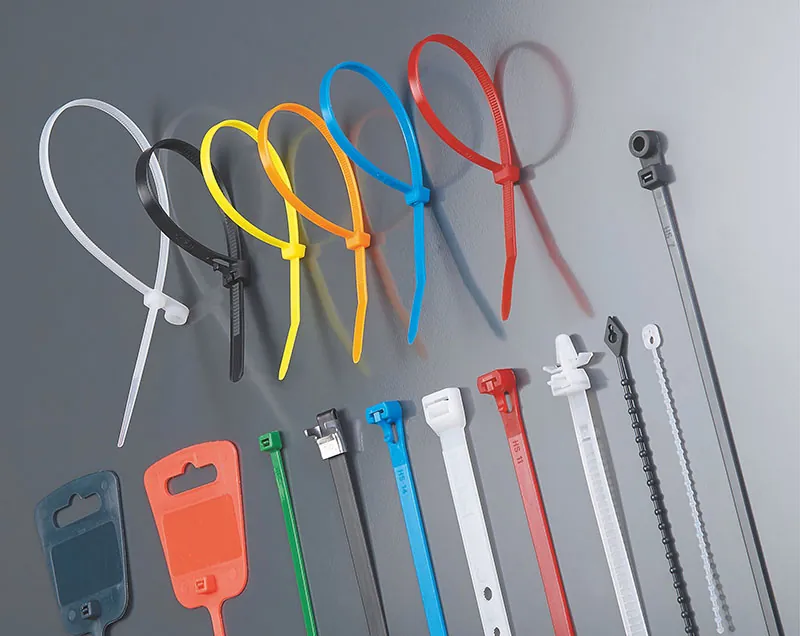
Every cable tie in the world descends from a problem observed in an aircraft factory in 1956. Boeing was building jet airliners whose wiring — thousands of feet of it — was laid out on 50-foot plywood boards and tied by hand with wax-coated braided nylon cord. Every knot had to be pulled tight by wrapping the cord around a finger, and operators regularly cut their hands raw doing it. An electrical engineer watching this decided there had to be a better way. Two years later he filed the patent that created an industry.
1958: The First Self-Locking Cable Tie
The engineer was Maurus C. Logan, then working in product development for an American electrical manufacturer. After touring the Boeing facility and experimenting with tools and materials, he filed a patent application on 24 June 1958 for a "cable bundling and supporting strap" — a flexible strap with a ratchet-and-pawl head that locked in one direction and could not release. The patent, U.S. 3,022,557, was granted on 27 February 1962.
Three things about that original design still define the product today:
- One-way locking. A pawl inside the head engages teeth on the strap. Tightening is possible; loosening is not. This is what makes a cable tie a single-use fastener — and what makes it reliable.
- Integral head. Nothing to assemble, nothing to lose. The fastener is one moulded part.
- Hand tensioning. A tie can be installed with fingers, and cut flush afterwards. No tools are strictly required, which is why it spread far beyond electrical work.
The earliest versions were metal. The migration to nylon is what made the product cheap, light, non-conductive, and ultimately ubiquitous.
1960s–1970s: From Aircraft to Everywhere
Adoption followed the industries that had the most wiring and the least tolerance for failure: aerospace first, then defence, then automotive, then telecommunications as networks spread. Each one added requirements the basic nylon tie could not meet — grip strength at vibration, resistance to oil and fuel, resistance to sunlight in outdoor plant. The patents covering the original locking concept were extended and refined through the 1960s, and competing manufacturers entered the market. By the 1970s the cable tie had become a genuine commodity component.
1980s–1990s: The Material Split
This is the period that produced today's catalogue. As applications diversified, so did the polymers and additives:
| Decade | What was added | What it solved |
|---|---|---|
| 1970s–80s | Carbon-black (UV) nylon | Outdoor and rooftop installation failure |
| 1980s | Heat-stabilized and PA46 nylon | Engine bays, ballasts, motors above +85°C |
| 1980s–90s | Flame-retardant (UL94 V-0) grades | Appliances, transit interiors, plenum spaces |
| 1990s | Stainless steel and coated steel-barb ties | Fire-rated trays, marine, chemical, furnaces |
| 1990s | Releasable, beaded, low-profile, marker ties | Re-entry, snag risk, cable identification |
| late 1990s | Metal-detectable compounds | Food and pharmaceutical foreign-object control |
Standards followed the products. The European standard IEC 62275 was developed to define performance classes for cable ties used in electrical installations, and North America converged on UL 62275 as its harmonized equivalent, superseding the older UL 1565. That harmonization is why a buyer today can ask for a "Type 21" classification and mean something precise about tensile and environmental performance.
2000s–2020s: Extreme Environments and Volume
Two trends defined the modern era. The first was extreme-environment engineering: fluoropolymer ties (PVDF, ETFE) for chemical plants and radiation areas, aluminium and stainless variants for offshore, and high-temperature grades for EV battery packs and power electronics. The second was automation: reel-fed ties and automatic tensioning tools turned cable tying from a hand operation into a machine operation on automotive and appliance harness lines, where cycle time is measured in seconds.
The most photogenic milestone came from space. Cable ties have flown on NASA Mars missions — Spirit, Opportunity, Curiosity and Perseverance — securing conduits and components where vibration, radiation and temperature swings are extreme and no maintenance is possible. Cumulative production of the original-branded tie alone passed 28–30 billion units by 2018; global output across all manufacturers runs several times higher.
2020s: Sustainability and the EV Transition
Three currents are shaping the current generation:
- Electrification. EV charging infrastructure, battery packs, and power electronics created new demand for UV-stable, flame-retardant and high-temperature ties — including the cable management requirements written into charging-equipment standards (see our EV charging guide).
- Bio-based and recycled polymers. PA11 derived from vegetable oil, and recycled-content nylons, are moving from samples to catalogue items.
- Traceability. IATF 16949 and PPAP requirements in automotive mean batch traceability and change control are now part of what a "cable tie supplier" has to provide, not an optional extra.
What This History Means When You Buy
The evolution above is the reason a cable tie specification has layers:
- Material tells you the environment it survives — this is the 1958–1990s story.
- Type classification (UL 62275 / IEC 62275) tells you the performance class — the 1990s–2000s standardization story.
- Process documentation (traceability, PPAP, material certificates) tells you whether a supplier can support a modern automotive or appliance programme — the 2010s onward story.
A quotation that gives you only a size and a price is answering a 1970s question.
Where We Sit in That Story
Our factory has been moulding nylon cable ties since 1997 — old enough to have lived through the material and standard transitions described above, and to hold the documentation modern buyers ask for. Our nylon and polypropylene ties are certified to UL 62275 under File E220676 (Type 21), and we manufacture across the full modern range from standard self-locking ties to heat-stabilized, metal-detectable and 304/316 stainless steel series.
If you are sourcing for a programme that needs certification evidence alongside the product, send us the requirement — we will respond with the file numbers, material data, and samples.