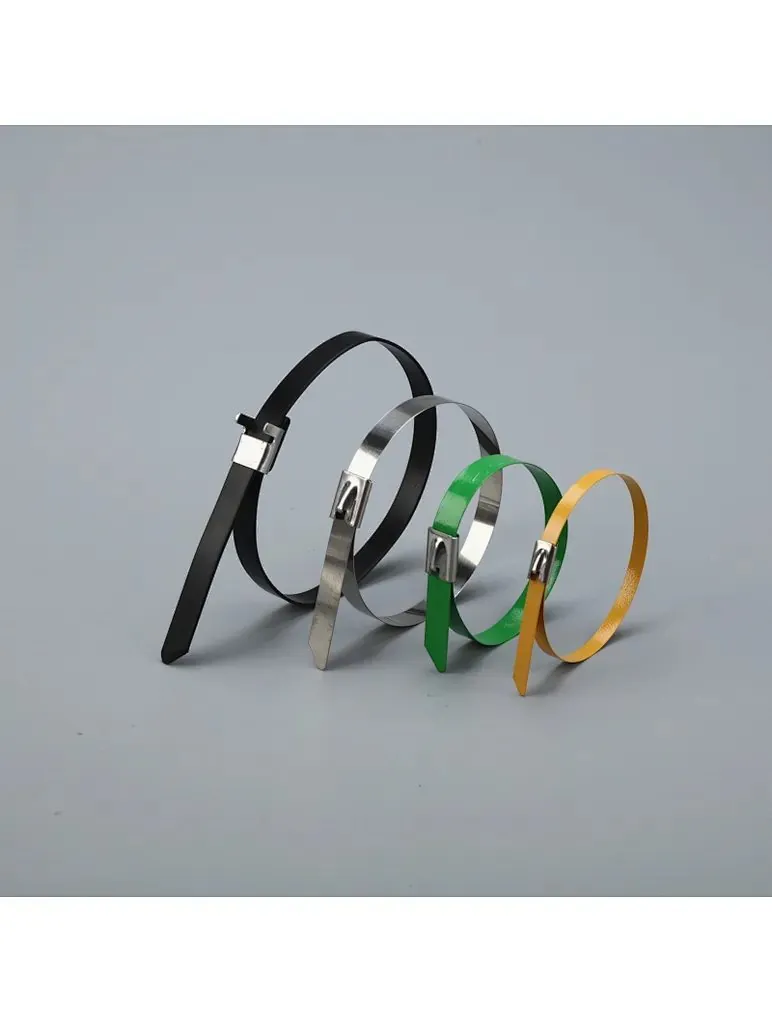
Two stainless steel cable ties can look identical, feel identical, and have the same tensile rating — and one will still be intact in fifteen years while the other is pitted and snapping in three. The difference is 2–3% molybdenum, an element you cannot see and that most quotations do not mention. This guide explains what separates 304 from 316, where the difference actually matters for a tie installation, and how to verify you received what you paid for.
The One Element That Changes Everything
Both grades are austenitic stainless steels. Both rely on a chromium-oxide passive layer for corrosion resistance. The difference is that 316 adds 2–3% molybdenum, and molybdenum is what stabilises that passive layer against attack by chloride ions — the mechanism behind pitting and crevice corrosion.
| Element | 304 | 316 / 316L | Why it matters |
|---|---|---|---|
| Chromium | 18.0–20.0% | 16.0–18.0% | Forms the passive layer |
| Nickel | 8.0–10.5% | 10.0–14.0% | Toughness, stress-corrosion resistance |
| Molybdenum | 0% | 2.0–3.0% | Chloride pitting resistance |
| Carbon (max) | 0.08% | 0.08% (0.03% for L grade) | Weldability, sensitization |
| Tensile strength | ≈ 485–515 MPa | ≈ 485–515 MPa | Essentially identical |
| PREN* | ≈ 18–20 | ≈ 24–28 | Quantified pitting resistance |
*PREN (Pitting Resistance Equivalent Number) = %Cr + 3.3 × %Mo + 16 × %N. The 3.3× weighting on molybdenum is why a small addition produces a large change in performance — a 25–40% improvement in PREN over 304.
Note what the table does not show: any meaningful difference in mechanical strength. For a cable tie, 304 and 316 hold the same load. The choice is purely a corrosion-environment decision.
What Actually Happens in Service
Stainless steel does not fail by turning uniformly brown. It fails by pitting: chloride ions breach the passive layer at a microscopic weak point, and the pit becomes self-sustaining, deepening below a surface that still looks acceptable. That is why a corroded tie can pass a visual inspection and still be structurally compromised.
The practical thresholds reported across industry testing:
- 304 resists chloride attack up to modest concentrations in moderate temperatures — commonly cited around a few hundred ppm — and is not suitable for immersion in seawater (which runs around 19,000 ppm chloride).
- 316 tolerates several times that chloride level, and is the minimum acceptable grade for seawater and aggressive industrial chloride exposure.
- In accelerated salt-spray testing (ASTM B117), 316 typically shows 3–5× the time to corrosion of 304.
- In marine immersion, 304 commonly shows pitting within 2–5 years; 316 typically lasts 10–15 years or more under the same conditions.
- Both grades are susceptible to chloride stress corrosion cracking above roughly 60°C — where hot chlorides are present, neither is sufficient and duplex grades (2205) or higher alloys are required.
Where 316 Is the Correct Specification
- Coastal and marine installations — sea air and spray reach everything exposed. If salt water can reach the tie, it must be 316.
- De-icing salt exposure — road tunnels, bridge structures, parking facilities in cold climates.
- Chemical plants and refineries — chlorinated compounds and acid atmospheres.
- Food processing with brine or chlorinated washdown — salt brines and hypochlorite cleaners attack 304.
- Water treatment and swimming pool plant rooms — chlorinated and humid.
- Offshore, shipboard and port equipment — permanent salt exposure plus vibration.
Where 304 Is Perfectly Adequate
304 is not an inferior product — it is the correct grade wherever chlorides are absent:
- Indoor cable trays, switchgear rooms, and data centres.
- Furnace, kiln, oven and exhaust applications where heat resistance matters far more than corrosion.
- Fire-rated cable support inside buildings.
- Inland, sheltered industrial environments with no salt or chloride chemistry.
- Food equipment in dry areas (both grades are food-contact acceptable).
Specifying 316 everywhere "to be safe" is a real cost item: material premium commonly runs 10–20% over 304, sometimes more for 316L. The sensible approach is to apply 316 only where chloride exposure is genuine — for example, ties on the exterior mast of a coastal site, but 304 inside the same cabinet.
Coated Steel Ties: What the Coating Actually Does
Stainless steel ties are also supplied with a nylon or epoxy coating. The coating is not primarily a corrosion treatment — it does two other jobs:
- Protects cable insulation. A bare steel band under tension plus vibration will saw into a soft jacket. The coating is the barrier.
- Reduces galvanic risk. Where a steel tie contacts a dissimilar metal in a wet environment, the coating separates the couple.
Inside the coating, the grade question is unchanged: coated 304 is still 304.
How to Verify You Got 316
Grade substitution — receiving 304 when 316 was specified — is a real supply-chain risk, because the two are visually identical and dimensionally identical. Three defences:
- Request the mill test certificate (MTC) with the order, and check that molybdenum is reported in the 2–3% range.
- PMI / XRF testing. A handheld X-ray fluorescence analyser identifies 304 vs 316 in seconds by detecting the molybdenum peak. Some buyers test incoming batches; a supplier who objects to this is telling you something.
- Ask the grade question in writing on every quotation. "Stainless steel" without a grade is not a specification.
Other Steel Tie Parameters Worth Checking
Grade is the corrosion decision, but four other numbers decide whether the tie works:
| Parameter | Typical range | Note |
|---|---|---|
| Continuous temperature | up to +538°C (uncoated) | Coated ties are limited by the coating, not the steel |
| Tensile strength | from light-duty up to several hundred kg | Varies widely with band width and thickness |
| Band width / thickness | 4.6 mm to 12 mm and beyond | Determines strength and stiffness |
| Locking type | Ball-lock, ladder, band-and-buckle | Ball-lock for speed and security; band-and-buckle for heavy loads |
Also confirm the cut-end handling: stainless ties leave a sharp tail. For installations in public or serviced spaces, specify a coated tie or a tool that cuts and rolls the tail.
Procurement Checklist
- Is chloride exposure real? (coastal, marine, de-icing salt, brine, chlorinated washdown) → if yes, 316.
- Is 316 required everywhere on the site, or only on exposed outdoor hardware? → apply it selectively.
- Does the tie contact cable insulation under vibration? → specify a coated tie.
- Has the supplier stated the grade and offered an MTC? → if not, request it.
- Does temperature exceed the coating's limit? → specify uncoated, and handle cut ends.
Our stainless steel cable tie range covers 304 and 316 in ball-lock, ladder and coated configurations, and our coated steel-barb ties combine a stainless locking element with a nylon jacket for vibration-heavy cable protection. For the wider material picture, see our cable tie materials guide.
Tell us the site environment and we will confirm the grade, provide the material documentation, and send samples for your own testing.