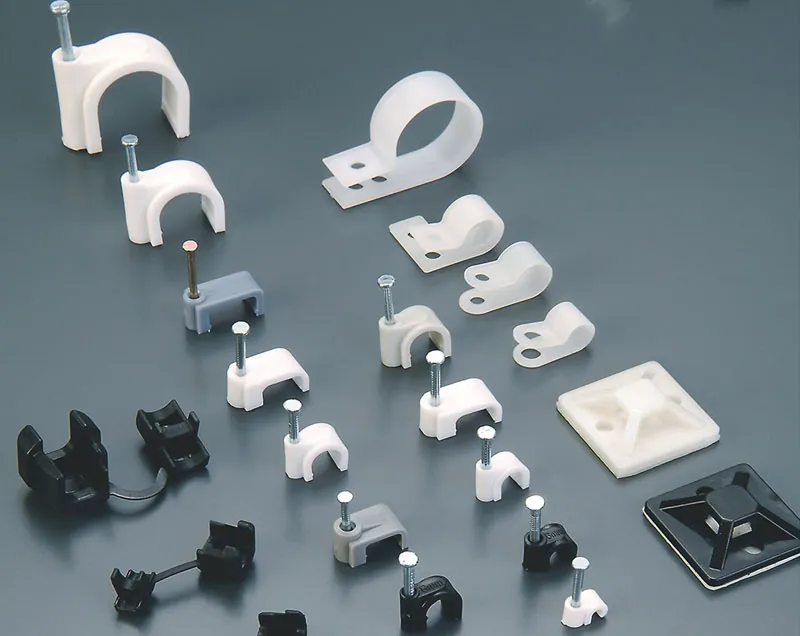
A cable nail clip costs a few cents. That is exactly why it gets specified carelessly — and why a bad batch shows up later as a callback on ten thousand installation points. This guide covers what a nail clip actually is, how circle, flat and coaxial types differ, how to match size to cable, why the material grade decides whether the clip survives a hammer blow, and what to verify before you place a bulk order.
What Counts as a Nail Clip
A nail clip is a one-piece fastener: a moulded plastic body with a pre-fitted steel nail already seated in the clip. The installer presses the cable into the clip, places the assembly against the surface, and drives the nail home with one hammer blow. There is no separate screw, no wall plug, no adhesive curing time, and nothing to drop.
That single-piece construction is the whole point. On a large wiring project the labour cost of installing a fixing is many times the cost of the fixing itself, so anything that removes a step — sorting nails, matching screws, waiting for glue — pays for itself immediately.
It helps to be precise about the category, because the words are used loosely:
| Product | How it fixes | Load it is designed for |
|---|---|---|
| Cable nail clip | Hammer-driven pre-fitted nail | Light — domestic and commercial surface wiring |
| Adhesive clip / tie mount | Self-adhesive pad | Very light, indoor, smooth clean surfaces |
| Screw-fix clamp | Screw or bolt through the body | Medium — panels, machinery, heavier cable |
| Cable cleat | Bolted, tested to IEC/EN 61914 | High — must restrain power cable during a short circuit |
A nail clip is the fastest of the four and the lightest-duty. Where the design calls for a short-circuit-rated restraint, a nail clip is not a substitute and must never be offered as one.
Three Families: Circle, Flat and Coaxial
Almost every nail clip sold falls into one of three body shapes, and the shape is chosen by the cable, not by preference.
1. Circle (Round) Nail Clips
The volume product. A circular cradle holds round cable — mains flex, lighting cable, conduit, hose — and the nail passes through the body on one side. Available from roughly 3.5 mm up to 40 mm in circle diameter, with single-nail and double-nail variants; the double-nail version resists rotation on larger diameters. This is the clip most buyers mean when they ask for a cable nail clip.
2. Flat Nail Clips
A flatter, wider cradle for flat and ribbon cable: communications cable, alarm and security cable, telephone and BT line, flat flex. The body holds the flat profile flush so the cable sits tidy against skirting or wall rather than twisting. Flat clips are usually specified where the cable itself is rectangular in section.
3. Coaxial Cable Clips
Shaped so the clip holds a coax cable without crushing the screen or deforming the dielectric. Coax clips are sized by a cable range rather than a single diameter — for example 3–5 mm, 5–7 mm, 7–10 mm — so one part number covers the tolerance spread of real cable. If you force a round clip onto coax you risk pinching the cable and degrading signal performance.
Matching Clip Size to Cable
Size to the outside diameter of the cable at its widest point — not the conductor size, not the nominal size printed on the jacket. A 6 mm cable takes a 6 mm clip. Too small and the body will not close over the cable; too large and the cable sits loose in the cradle and the nail will not pull the assembly tight to the surface.
For reference, this is the full circle nail clip range we manufacture:
| Item No. | Height (mm) | Circle dia. (mm) | Nail (mm) |
|---|---|---|---|
| HSR-0305 | 5.3 | 3.5 | 2 × 19 |
| HSR-4 | 5.3 | 4 | 2.3 × 18 |
| HSR-5 | 6.3 | 5 | 2.3 × 18 |
| HSR-6 | 7.4 | 6 | 2.3 × 22 |
| HSR-7 | 8.4 | 7 | 2.3 × 22 |
| HSR-8 | 9.4 | 8 | 2.3 × 22 |
| HSR-9 | 10.4 | 9 | 2.3 × 22 |
| HSR-10 | 11.4 | 10 | 2.3 × 27 |
| HSR-12 | 13.4 | 12 | 2.3 × 25 |
| HSR-14 | 16.4 | 14 | 2.3 × 30 |
| HSR-16 | 17.7 | 16 | 2.3 × 32 |
| HSR-18 | 19.7 | 18 | 2.7 × 40 |
| HSR-20 | 22.2 | 20 | 3 × 42 |
| HSR-22 | 25.0 | 22 | 3 × 42 |
| HSR-25 | 27.7 | 25 | 3 × 45 |
| HSR-30 | 33.1 | 30 | 3.5 × 55 |
| HSR-32 | 35.6 | 32 | 3.5 × 55 |
| HSR-35 | 36.6 | 35 | 3.5 × 58 |
| HSR-40 | 45.2 | 40 | 3.5 × 62 |
Note how the nail grows with the clip: a 4 mm clip is fixed with a 2.3 × 18 mm nail, a 40 mm clip with a 3.5 × 62 mm nail. The nail has to reach through a deeper body into sound substrate, so the two cannot be specified independently. Full dimensional drawings for every size are on the circle cable clips page, and the flat range is listed on the flat cable clips page.
Material: Why the Grade Decides Everything
Nail clips are almost always moulded in polyethylene (PE), sometimes polypropylene (PP). The difference between a clip that survives installation and one that cracks in the hand is almost never the shape — it is whether the moulder used virgin resin.
- Virgin PE — retains elasticity and impact resistance across the whole service range, typically −40°C to +85°C. The clip flexes open, grips the cable, and does not crack when the hammer lands.
- Recycled or heavily filled PE — cheaper per kilogram and the source of most field complaints. Elasticity is already partly consumed, so the body becomes brittle, the snap force weakens, and the nail hole loses its grip. Clips crack at the hinge or pop off the wall within a season.
- PP — harder and slightly stiffer, with good chemical resistance; useful where a firmer body is wanted, but less forgiving than PE on cold installation.
- UV-stabilised grades — required for any exterior run. Unstabilised PE exposed to sunlight embrittles and fails in the same way recycled material does.
This is a material question, not a price question, and it is invisible on a photograph. If you cannot get a material declaration, you cannot tell virgin from recycled before the pallet arrives — which is why we supply material certificates on request alongside the goods.
The Nail Is Half the Product
The nail in a quality clip is galvanised carbon steel — the zinc coating is what stops the nail rusting and staining the wall within a year. Two checks separate a good clip from a bad one:
- Is the nail pre-seated in the body? If the nail arrives loose in a separate bag, the labour saving is gone and installers will lose nails.
- Does the nail grip the body before driving? A clip that sheds its nail when picked up was assembled out of tolerance and will cause fumbling on site.
Nail diameter and length must match the clip size — a nail too short will not reach sound material, too thin will bend on the first strike. The table above lists the correct pairing for every size we make.
Match the Fixing to the Wall
A nail clip is designed for timber, plasterboard, skirting, soft masonry and composite board. Driving one into concrete or hard brick will bend the nail, mushroom the clip, and leave the cable loose — a failure that is easy to avoid by specifying the right product at quotation time.
For harder surfaces and higher loads, move up the range:
- R-type cable clamps — nylon, screw-fixed, 12 sizes, for solid walls and panel work
- Expand nails — wall plugs that expand on insertion for a firm grip in hollow and solid walls
- Self-adhesive clamps and adhesive tie mounts — for smooth, clean, indoor surfaces where drilling is not wanted
- Locking wire saddles — for routing inside panels and enclosures
Nail Clips Are Not Cable Cleats
This matters on any project with real fault current. A nail clip positions a cable; it does not restrain it. Under short-circuit conditions the electromagnetic force between conductors can reach thousands of newtons — many times the weight of the cable — and only a cable cleat tested to IEC/EN 61914 is designed and rated to hold against it.
The cleat standard tests products for short-circuit withstand, axial and lateral load, impact resistance, UV aging (700 hours of xenon-arc exposure) and corrosion resistance (salt-spray testing of metal components, 18 or 192 hours depending on the declared class). None of that applies to a nail clip, and a nail clip is never a compliant substitute wherever the specification says "cleat". If your project uses cleats on the power side, the clips on the control and lighting side are a different purchase entirely — and do not confuse them in a bill of materials.
Installing Them Properly
Three habits prevent most complaints:
- Space them by the applicable code, not by feel. In the US, the NEC requires NM-B cable to be supported at intervals of 4.5 ft (1.4 m) and within 12 in of boxes and fittings; structured-cabling practice typically uses a maximum 1.5 m support spacing for horizontal data runs. Check the code that governs your installation.
- Do not install below 0°C. PE stiffens in the cold and impact resistance drops; a clip installed in freezing conditions can crack at the hinge even if it is perfectly good material.
- Hammer the nail, not the body. Striking the plastic deforms the cradle and can crack it; the nail head should take the blow squarely.
What to Check Before You Order
A short checklist for importers, distributors and contractors buying in volume:
- Material declaration — virgin PE or not, and which UV grade.
- Nail specification — steel grade, zinc coating, and confirmation the nail is pre-fitted.
- Size coverage — can one supplier cover the full 3.5–40 mm range so you are not mixing sources across a job?
- Colour and packaging — white is standard and always in stock; grey, black and custom colours are usually OEM lead-time items. Standard packing is 100 pcs per bag, with 200, 500 and bulk carton available.
- OEM capability — polybag print, retail box and carton printed with your own brand, sample approved before mass production.
- Consistency between shipments — ask for the same mould and resin batch policy in writing, because a second batch of recycled material is a common way for a cheap quote to become an expensive one.
For the wider picture — how clips sit alongside clamps, glands and mounts — see our cable clips, clamps and glands buying guide, and if you bundle cables as well as fix them, start with how to choose cable ties.
Where to Start
Our cable clips and clamps range covers circle nail clips from 3.5 mm to 40 mm, flat clips for comms and alarm cable, coaxial clips sized by cable range, plus R-type clamps, expand nails and adhesive mounts — all made in our own moulds, in virgin PE, with the nail pre-fitted.
Send us the cable outside diameter, the mounting surface and your annual volume, and we will confirm the correct size, send samples, and quote for OEM packing under your own brand. Our quality system is certified to ISO 9001, ISO 14001, ISO 45001 and IATF 16949 — see certifications or contact us directly.