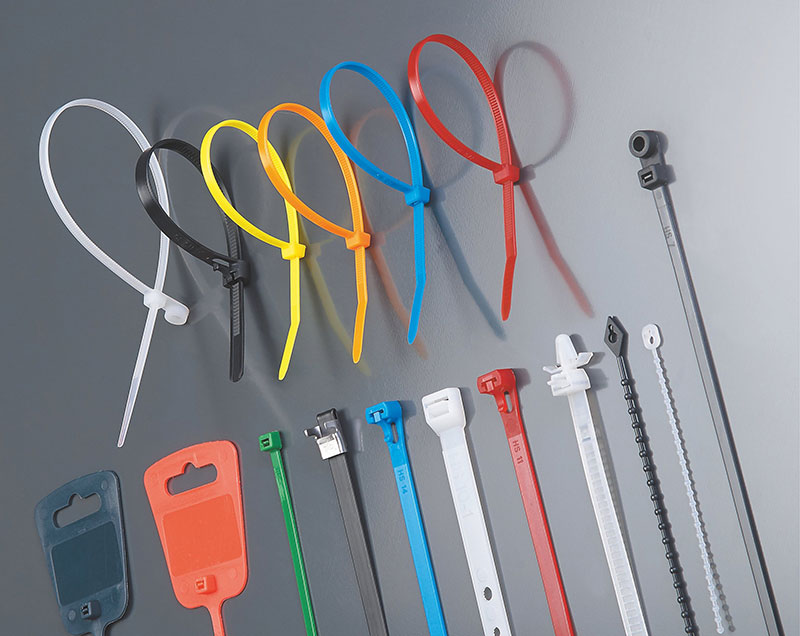
A cable tie is one of the cheapest components in a wiring harness — but choosing the wrong one can shut down a production line, void a warranty, or fail an inspection in the field. This guide walks procurement engineers and buyers through the six decisions that matter: material, size, tensile strength, environment, certification, and supplier capability. By the end, you will know exactly which tie to specify — and what to ask before you place a bulk order.
Why Getting Cable Tie Selection Right Matters
Cable ties are rarely the most expensive line item on a BOM, yet they are one of the most common causes of field failures. A standard PA66 tie looks identical to a heat-stabilized version — until the harness sits near a hot motor for a few thousand hours and the plastic turns brittle. A nylon tie in a UV-exposed outdoor panel can crack within two years without the right stabilizer package. And in food or pharmaceutical plants, a missed metal-detectable requirement can mean a full batch recall.
The good news: tie selection follows a repeatable process. Work through the six steps below and you can specify with confidence, whether you are buying 1,000 pieces for a prototype or 500,000 for annual production.
Step 1: Choose the Right Material
Material is the single most important decision. It determines operating temperature, strength retention, chemical resistance, flammability, and cost. For industrial cable management, almost all ties fall into two families: nylon (polyamide) and stainless steel.
| Material | Key properties | Best for |
|---|---|---|
| PA66 nylon | Good strength and stiffness, -40°C to +85°C continuous, low cost, wide color range | General electronics, wiring harnesses, panels, bundling |
| PA6 nylon | Slightly softer and more flexible than PA66, lower cost | Light bundling, consumer products |
| Heat-stabilized PA66 / PA46 | Continuous rating up to +105°C to +150°C, resists long-term heat aging | Engine compartments, motors, ovens, LED drivers |
| Flame-retardant PA66 (UL94 V-0) | Self-extinguishing, passes glow-wire tests | Appliances, power supplies, railway, aerospace interiors |
| Stainless steel (304/316) | Extreme heat, UV, chemicals, weatherproof; highest strength | Outdoor, marine, chemical plants, heavy industrial, fire-rated areas |
| Metal-detectable nylon | Contains ferrous additive detectable by X-ray/metal detectors | Food processing, pharmaceuticals, cleanrooms |
If your application runs below +85°C and indoors, standard self-locking PA66 nylon cable ties will cover most cases at the lowest cost. Step up to heat-stabilized ties when ambient temperature exceeds that, and switch to stainless steel ties for outdoor, high-heat, or chemical environments.
Step 2: Size, Length and Tensile Strength
Tie sizes are specified by three numbers: width, length, and maximum bundle diameter. The tensile strength (loop tensile) is the force the tie can hold before the head or strap fails — this is the number engineers care about most.
| Typical width | Common lengths | Max bundle Ø | Loop tensile | Typical use |
|---|---|---|---|---|
| 2.5 mm | 75–150 mm | 16–35 mm | 8–18 kg (18–40 lb) | Small electronics, wire pairs |
| 3.6 mm | 100–200 mm | 22–50 mm | 18–22 kg (40–50 lb) | General harness bundling |
| 4.8 mm | 150–370 mm | 35–100 mm | 22–50 kg (50–110 lb) | Standard industrial bundling |
| 7.6 mm | 200–530 mm | 50–140 mm | 55–80 kg (120–175 lb) | Heavy cables, conduit, truck harnesses |
| 9.0 mm | 300–780 mm | 80–200 mm | 80–130 kg (175–285 lb) | Very large bundles, structural fixing |
Two practical rules: choose a tie whose length is at least twice the bundle diameter plus 50 mm for tail grip, and never spec the tie at its maximum tensile rating — real-world clamping force is roughly 60–70% of the listed value once the tie wraps around a bundle.
Step 3: Match the Environment
Beyond raw strength, three environmental factors silently kill nylon ties:
- Heat. Continuous exposure above +85°C accelerates hydrolysis and embrittlement. Use heat-stabilized grades — for example our PA46 heat-stabilized ties hold their mechanical properties at sustained high temperatures where standard nylon fails.
- UV and weather. Outdoor sunlight degrades unstabilized nylon. Black ties with carbon-black stabilization resist UV far better than light colors. For permanent outdoor fixing, stainless steel is the definitive answer.
- Fire. If the assembly must pass UL94 V-0 or IEC 60332 flame tests, specify flame-retardant V-0 cable ties — especially for appliances, power distribution, and public-transport interiors.
Cold environments deserve a special mention: standard ties get brittle below -40°C. For refrigeration, cold-chain logistics, or freezer applications, our cold-weather cable ties retain flexibility at low temperatures.
Step 4: Verify Certifications Before You Buy
Certification is not paperwork — it is the legal and technical proof that the tie will behave as specified. For cable ties sold into regulated markets, check at minimum:
| Certification | What it covers | Why it matters |
|---|---|---|
| UL 62275 | Tie performance, flammability, temperature rating | Required for many UL-listed end products; speeds up your own UL file |
| RoHS / REACH | Restricted hazardous substances (lead, phthalates, etc.) | Mandatory for EU market and most global OEMs |
| UL94 V-0 | Flammability rating | Needed for appliances and electronics housings |
| ISO 9001 / IATF 16949 | Factory quality system (automotive-grade) | Proves consistent quality for automotive and industrial OEMs |
A reliable supplier should be able to send you test reports and certificate copies on request. At Yueqing Huihua Electronic, our cable ties carry UL, CE, RoHS and REACH approvals, and the factory operates under ISO 9001, ISO 14001, ISO 45001 and IATF 16949 certified systems.
Step 5: Match the Tie to the Application
Once the basics are covered, choose the specific tie type that fits your assembly process and field requirements:
- Standard self-locking ties — the workhorse for most harnesses: self-locking nylon cable ties.
- Releasable ties — where harnesses are reworked or cables moved during service: releasable cable ties can be opened and re-closed repeatedly.
- Push-mount / arrow-head ties — for fixing a harness to a panel with a pre-drilled hole: push-mount cable ties eliminate screws and clips.
- Marker ties — for identification in dense wiring: printable marker ties speed up assembly and service tracing.
- Metal-detectable ties — mandatory in food contact and pharma zones: metal-detectable cable ties are locatable by inspection equipment if they break loose.
- Steel ties with nylon coating or barbed designs — combine steel strength with insulation: stainless steel barb nylon ties grip without a traditional head.
Browse the full range in our cable ties collection — 21 series including standard, releasable, heat-resistant, V-0 flame-retardant, metal-detectable, low-profile, and reel-fed ties for automated installation.
Step 6: Bulk Purchasing — What to Ask Before You Order
When you move from samples to production volumes, add these questions to your RFQ:
- MOQ and price breaks. Ask for tiered pricing at 10k, 50k, and 100k+ pieces — unit cost drops significantly with volume.
- Lead time. Standard colors and sizes usually ship faster; custom colors or printed tails add lead time.
- Packaging. Reel-fed ties for automated tools, poly-bag packs, or bulk cartons — packaging affects your line-side handling cost.
- Customization. Custom colors, laser printing, special head shapes, or custom lengths are common for OEM programs.
- Sampling. A serious supplier sends samples and test reports before the PO — expect a 7–14 day sample cycle for custom items.
As a manufacturer rather than a trading company, Huihua Electronic controls tooling and molding in-house, which means faster customization, stable quality, and direct factory pricing — no middleman markup.
5 Common Cable Tie Buying Mistakes (and How to Avoid Them)
- Judging ties by look alone. Two identical-looking ties can differ 3× in tensile strength. Always ask for the datasheet and test report.
- Ignoring continuous temperature. If the datasheet says +85°C, that is the ceiling — not a comfortable margin. De-rate by 15–20°C in enclosed spaces.
- Skipping flame and chemical requirements. Verify UL94 and chemical resistance against the actual fluids in your environment (oils, solvents, coolants).
- Buying from traders at rock-bottom prices. The cheapest quote often means unstabilized regrind material — brittle, weak, and inconsistent batch to batch.
- Forgetting the application process. If your line uses automatic tie guns, reel-fed ties or specific head profiles matter more than price.
Final Checklist Before You Place the Order
Run through this checklist with your supplier and you will not go wrong:
- Material grade confirmed (PA66, PA6, heat-stabilized, steel, metal-detectable)
- Continuous temperature rating matches your worst-case environment
- Tensile strength de-rated to 60–70% of datasheet value
- Length ≥ 2 × bundle diameter + 50 mm
- UL / CE / RoHS / REACH certificates and test reports received
- MOQ, lead time, packaging, and customization agreed in writing
- Sample batch approved before mass production
Still unsure which tie fits your project? Send us your bundle size, temperature range, and application photos — our engineers will recommend the exact series and send samples within days.