If you export cable ties, cable harnesses, or electrical equipment to North America, you have probably seen both "UL 62275" and "IEC 62275" in datasheets — and wondered whether they describe the same thing, which one your customer actually needs, and why a tie can carry one marking but not the other. The short answer: UL 62275 is the North American edition of IEC 62275. They share the same technical core, and the difference matters mainly in how the tie is certified and where it is allowed to be installed. This guide explains the relationship, the differences that affect your purchasing decision, and what to verify before you place an order.
First, What These Standards Actually Cover
Both standards are titled Cable management systems — Cable ties for electrical installations. They specify requirements for metallic, non-metallic (polymeric) and composite cable ties and their associated fixing devices — edge clips, screw mounts, push mounts, adhesive mounts — used to bundle, secure and support wiring systems in electrical installations. A cable tie standard covers a lot more than tensile strength: it defines test methods and declared ratings for loop tensile strength, temperature limits, UV resistance, flammability contribution, corrosion (metallic ties), vibration and more.
The Relationship: One International Standard, Two Editions
IEC 62275 is the international baseline, developed by the International Electrotechnical Commission. It exists so that cable ties can be specified and tested against a single worldwide reference. The IEC standard was substantially revised over time — Edition 2 was published in 2013, and Edition 3 followed in August 2018.
UL 62275 is the United States national adoption, published by UL Solutions and recognized as an ANSI standard. Crucially, it is not a separate standard that competes with IEC 62275. In North America, UL 62275, CSA C22.2 No. 62275 (Canada) and NMX-J-623-ANCE (Mexico) were developed as one harmonized tri-national standard: UL and CSA adopt the original IEC text and add national differences — flagged as "DV" (deviation) clauses — that address the specific safety and regulatory context of the North American installation codes (NEC in the US, CE Code in Canada, NOM in Mexico).
The practical implication for buyers: a cable tie engineered and tested to IEC 62275 carries the same core performance logic as one tested to UL 62275, and a single manufacturing and test program can support both. What differs is the certification structure and the installation rules attached to it in North America.
A Quick Version Timeline
| Standard | Key editions | Notes |
|---|---|---|
| IEC 62275 | Ed. 2 (2013); Ed. 3 (Aug 2018) | International baseline; adopted in Europe as EN 62275 |
| UL 62275 | 1st ed. (Feb 2010); Ed. 2 (2016); Ed. 3 (Sep 2021); Ed. 4 (2025) | US national adoption, harmonized with Canada and Mexico |
| CSA C22.2 No. 62275 | 3rd ed. (2021), aligned with UL Ed. 3 | Canadian counterpart of the same harmonized document |
One historical point matters if you are looking at older stock or legacy approvals: before UL 62275 existed, cable ties in North America were evaluated under UL 1565 / CSA C22.2 No. 18.5, "Positioning Devices." Those cable tie requirements were retired in June 2014. If a supplier still markets a tie purely on a UL 1565 listing, treat that as outdated and ask for the UL 62275 record.
The "Type" Classifications You Will See on Every Datasheet
The most visible difference between the IEC text and its North American adoption is the Type designation system. IEC 62275 defines the two basic types; the UL/CSA editions add more, and each Type tells you the material family, the strength test used, and the certification route.
| Type | Material | Strength evaluation | UL certification | What it signals |
|---|---|---|---|---|
| Type 1 | Non-metallic / composite | Breaking test after conditioning | Recognized | Basic classification from IEC 62275 |
| Type 11 | Non-metallic / composite | Breaking test | Recognized | Type 1 plus polymer long-term thermal investigation (per UL 746B) |
| Type 2 | Metallic, non-metallic / composite | 1-minute withstand at declared strength | Listed | Basic classification from IEC 62275 |
| Type 21 | Non-metallic / composite | 1-minute withstand | Listed | Type 2 plus polymer long-term thermal investigation |
| Type 2S | Metallic, non-metallic / composite | 5-minute withstand at declared strength | Listed | "S" = suitable for primary support of cable and flexible conduit/tubing per code |
| Type 21S | Non-metallic / composite | 5-minute withstand | Listed | Type 2S plus polymer long-term thermal investigation |
Three things buyers routinely misread in this table:
- The "1" in Type 11, 21 and 21S is not a higher strength grade. It marks a separate investigation of the polymeric material's long-term thermal endurance (referenced to ANSI/UL 746B). A Type 11 tie is not mechanically stronger than a Type 1 tie of the same dimensions.
- The "S" suffix is about support. Type 2S/21S ties are investigated for securing and supporting cable, flexible conduit or flexible tubing in building construction where the relevant electrical code permits, and they declare a loop tensile of at least 222 N (50 lbf) held for an extended period. If your application is simple bundling, you usually do not need the S types.
- All-metallic ties classify only as Type 2 or 2S. The 1-suffix polymer investigation does not apply to fully metallic products.
Listed vs. Recognized: The Distinction That Decides Whether You Can Use the Tie
This is the part that most often creates friction between a buyer and their end customer. UL 62275 certification comes in two forms, and they serve different purposes:
- Listed (the familiar "UL Listed" mark): the product is evaluated for field installation in accordance with the National Electrical Code (NEC). A Listed tie can be used directly in building and field wiring installations, and to provide primary support where its Type 2S/21S rating applies.
- Recognized (the backward "UR" Component mark): the product is evaluated as a component for factory installation inside another device, appliance or piece of equipment — for example, a cable tie used inside a control panel, appliance or wiring harness that the equipment manufacturer assembles. This is the category most component and harness suppliers actually deal in.
Neither is "better" — they answer different questions. If you are a harness maker or equipment manufacturer sourcing ties for your own assembly, a Recognized component tie is normally what your UL file references. If you sell ties for contractors to install in the field, you need the Listed route. When your customer's spec says "UL 62275," ask which: Listed or Recognized. Getting this wrong is the single most common reason a shipment is rejected at audit.
Flammability: Note the Difference from UL 94
UL 62275 evaluates a tie's contribution to fire using needle-flame style testing appropriate to a small part inside an installation. This is not the same as the UL 94 V-0/V-2 material flammability classification that many buyers already know. A tie can legitimately carry a UL 62275 certification, a UL 94 V-0 material rating, both, or neither — the two are evaluated under separate programs. If your end product must meet a UL 94 requirement and your customer asks for UL 62275, confirm the tie covers both and ask to see each record.
What to Verify Before You Buy
A printed "UL" logo on a bag proves nothing by itself. Certification is tied to a specific product file and manufacturer location. When a supplier claims UL 62275, ask for:
- The UL file or certificate number — then look it up yourself in UL's online Product iQ directory. The record must be active and list the exact part number you are buying.
- The Type designation and temperature ratings — Type 1/11/2/21/2S/21S, the declared operating temperature range, and (for outdoor use) the UV test basis.
- Listed or Recognized — confirm it matches your end use (field installation vs. factory component).
- Material records where relevant — for polymeric ties sold under the 1-suffix types, the polymer's long-term thermal investigation is part of the story.
- The manufacturer's name and plant — certification records are plant-specific. A certificate from one factory does not cover the same product made elsewhere.
How This Affects Your Specification
In practice, most exporters fall into one of two camps:
- You build equipment, panels or harnesses for North America. Your customer's UL file will normally call for Recognized component ties of a specific Type and temperature class. Standardize on those part numbers across projects to simplify your own file maintenance.
- You distribute ties to electrical contractors and installers. You need Listed products whose Type 2S/21S support ratings match the intended code applications, with clear package markings for the inspector.
Because UL 62275 and IEC 62275 share the same technical foundation, choosing a manufacturer that can document both the international test data and the North American certification record simplifies qualification — one product, one test program, two markets.
Sourcing Certified Ties Without the Guesswork
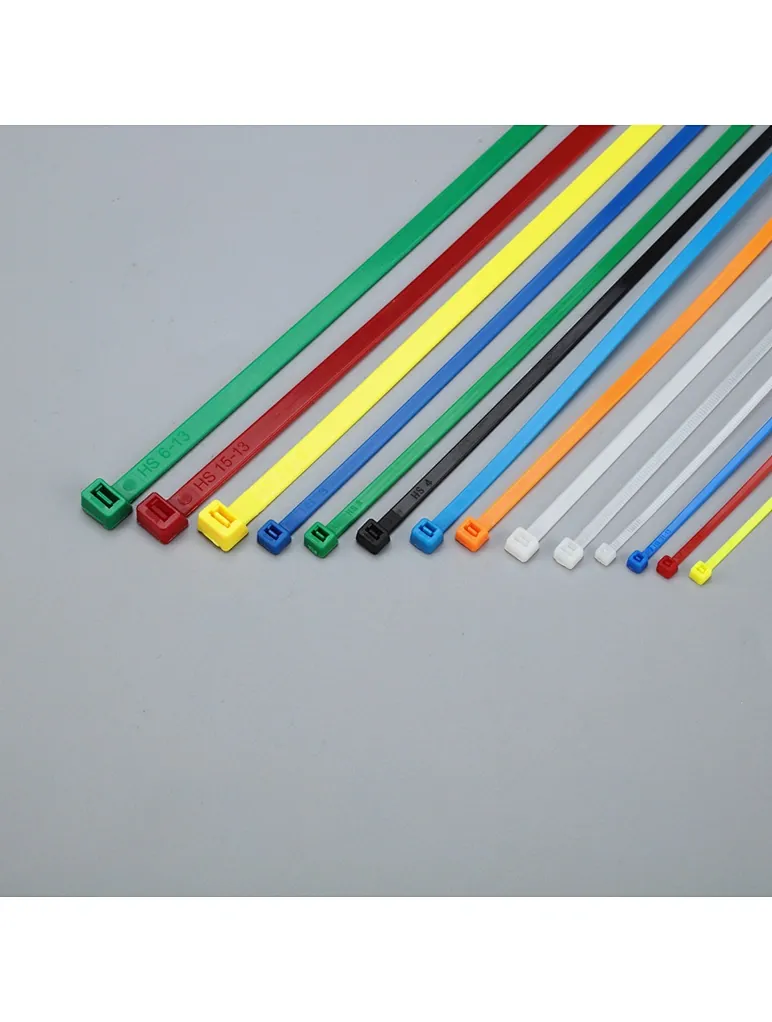
As a manufacturer of nylon and steel cable ties since 1997, we deal with these records daily. Our HS-series nylon cable ties are certified to UL 62275 under UL File No. E220676 — a Certificate of Compliance issued to Yueqing Huihua Electronic Co., Ltd. (report reference E220676-2020-09-17). The covered models carry the Type 21 classification described above (the "-21" suffix in HS part numbers), alongside UV-black "-UVB" variants, and the full model list is publicly verifiable in UL's Product iQ directory. Our wider cable tie range is documented against the standards your projects need, including self-locking nylon ties for component and harness use, flame-retardant grades where flammability matters, and heat-stabilized variants for elevated temperatures. When you evaluate a specific part number, ask us for its current UL file details — we will share the record so you can confirm the Type classification and ratings yourself before you order. Not sure which Type or certification route your customer's spec calls for? Send us the requirement with the operating temperature, and our engineers will confirm the right rating and provide samples for your qualification.