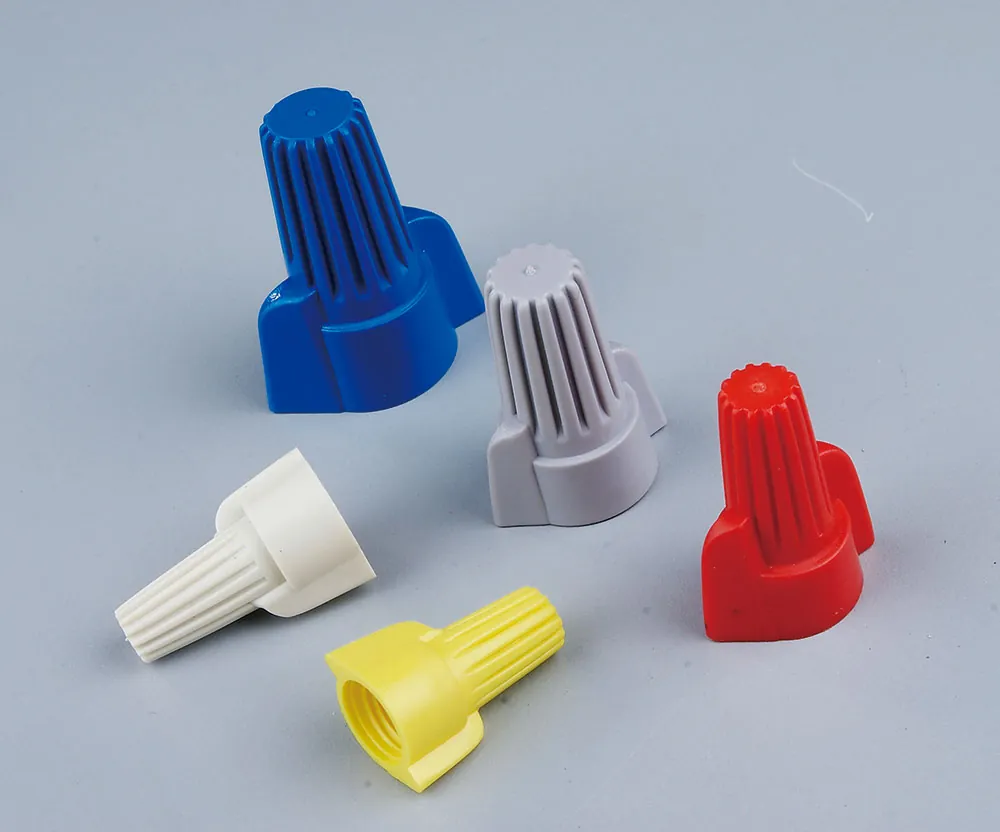
If you buy or sell twist-on wire connectors — the color-coded caps electricians call wire nuts — you will eventually run into a UL certification question. The connector may look identical to the market leader, but if it is not certified to the right standard and covered by a real UL file, it can fail an inspection, void an equipment listing, or stop a shipment at your customer's dock. This guide explains the standard behind wire nut certification, what a UL file actually proves, and how to check a supplier's claim — including the file behind our own twist-on wire connectors.
Why Wire Nut Certification Matters in North America
A twist-on wire connector (wire nut) joins two or more copper conductors inside a single insulated cap; an internal metal coil grips the stripped ends as the cap is twisted on, forming the splice. In North American wiring, that splice is not optional hardware — it is regulated. The National Electrical Code (NEC), Article 110.14(B) requires conductors to be spliced with devices "identified for the use," and NEC 110.3(B) makes the manufacturer's published installation instructions and wire-combination ratings enforceable. In practice that means an electrical inspector checks two things on every box of connectors: the certification mark and whether the wire combination you made up is inside the rated combination matrix printed on the package.
That is why a distributor or contractor asks for "UL listed wire nuts" rather than just "wire nuts." A connector without a valid file is, for code purposes, not an identified splicing device at all.
The Standard: UL 486C and Its North American Family
Twist-on connectors are evaluated under UL 486C, "Splicing Wire Connectors." The name covers more than wire nuts — the UL scope includes insulation-piercing and displacement connectors, spring-action connectors, tool-applied crimps, set-screw connectors and similar single-polarity splicing devices for conductors of 6 AWG and smaller. But twist-on connectors are the category most buyers meet first.
Like the cable tie standard we wrote about earlier, UL 486C is not an isolated US document. It is published as one harmonized tri-national standard together with Canada and Mexico:
| Country | Standard number | Current edition |
|---|---|---|
| United States | UL 486C, Splicing Wire Connectors | 8th ed. (2023), reprint with revisions through Feb 2025 |
| Canada | CSA C22.2 No. 188, Splicing wire connectors | 5th ed. (2023) |
| Mexico | NMX-J-548-ANCE | 5th ed. (2023) |
The three national bodies (UL Standards & Engagement, CSA Group and ANCE) publish the same technical text simultaneously — the 8th edition of UL 486C, the 5th edition of CSA C22.2 No. 188 and the 5th edition of NMX-J-548-ANCE were released together in 2023, superseding the 2021 editions. A connector certified to this harmonized standard can therefore carry US and Canadian certification from one test program. The latest UL reprint (revised through 21 February 2025) adds new requirements — including testing for the line side of service qualification and revisions to copper-clad aluminum requirements — that become effective for new certifications in February 2027.
Practical takeaway for buyers: when a datasheet says "UL 486C / CSA C22.2 No. 188," it is pointing at one harmonized family, not two competing standards. For a product sold into both the US and Canada, ask whether the certification covers both countries under the same file.
What Certification Testing Actually Covers
UL 486C testing is far more demanding than "does it twist on." The evaluation program for twist-on connectors includes thermal cycling, current-carrying and temperature-rise tests against the connector's declared ratings, dielectric voltage-withstand, mechanical strength and pull-out tests, corrosion and stress-corrosion testing, and flammability of the insulating shell. The connector is tested with the conductor types and sizes it will be rated for — copper, aluminum, or copper-clad aluminum (note: copper-clad aluminum is permitted only in the United States; in Canada it is not allowed). A listed connector's ratings — wire sizes, wire count combinations, temperature class — are defined by this test program and printed on the package.
Sizing Wire Nuts: Color Is a Hint, the Combination Matrix Is the Law
Wire nut shells are color-coded by size, and the industry convention (using the well-known Ideal equivalents) looks roughly like this:
| Typical color | Common wire range (typical) | Typical use |
|---|---|---|
| Gray | 2 × #22 to 2 × #16 AWG | Thermostat and signal wiring |
| Blue | 2 × #22 to 2 × #14 AWG | Small-gauge lighting leads |
| Orange | 2 × #18 to 3 × #14 AWG | Light fixtures, small device splices |
| Yellow | 2 × #18 to 4 × #14 or 3 × #12 AWG | Standard 15 A and 20 A branch circuits |
| Red | 2 × #18 to 4 × #12 or 3 × #10 AWG | Larger branch-circuit splices |
Colors vary slightly between manufacturers, so the color alone is never the spec. The authoritative statement is the wire-combination matrix printed on each package and in the listing record. Three sizing rules prevent most field failures:
- Do not overstuff. Forcing more conductors into a cap than its rated combination can let the spring bite unevenly and create a high-resistance joint.
- Do not undersize. A cap rated for larger conductors may not grip small-gauge wires firmly enough to hold under thermal expansion.
- Match the conductor material. Standard copper-rated caps must not be used on aluminum branch-circuit conductors, which need connectors specifically investigated for aluminum (with appropriate oxide-inhibiting measures) to resist cold creep and galvanic corrosion.
What Field Inspectors Look For
Most installation defects come down to workmanship around a correctly certified connector:
- No bare conductor below the skirt — strip so the insulation seats near the cap opening; exposed copper below the insulated shell is a classic inspection failure.
- Respect the combination matrix — the inspector may check the wire make-up against the package chart.
- Twist until the spring seats, then tug each conductor individually — a properly made splice should hold each wire against a firm pull.
- Follow the manufacturer's pre-twist guidance for solid-to-stranded mixes; some makers recommend pre-twisting stranded combinations, others do not. The instruction sheet governs.
Our Wire Connector File: UL E308136
As a manufacturer of wiring accessories since 1997, we certify our twist-on splicing wire connectors under UL Solutions File No. E308136, held by Yueqing Huihua Electronic Co., Ltd. (No. 177 Wei 12 Road, Yueqing Economic Development Zone, Zhejiang, China). The file is publicly verifiable in UL's online Product iQ directory — the same directory where your customers and inspectors look up our record:
| Item | Record details |
|---|---|
| UL file number | E308136 (last updated 2024-12-06) |
| File holder | Yueqing Huihua Electronic Co., Ltd. |
| Product category | Splicing wire connectors — Wire Connectors and Soldering Lugs |
| US record | Models HP11, HP12, HP13, HP15, HP17, HS-4 22-14# |
| Canadian record | Models HP11, HP12, HP13, HP15, HP17 — certified for Canada |
If your project is in the United States, the HP models in our file appear on the US record; if you sell into Canada, the same HP series carries the Canadian certification record. The HS-4 22-14# model, named for its 22–14 AWG working range, is listed on the US record.
Checklist: Verifying a Wire Nut Supplier's UL Claim
- Get the file number and look it up yourself in UL Product iQ. The record must be active, held by the manufacturer you are actually buying from, and list the exact model you are buying.
- Confirm country coverage — does the record (or a companion record) cover the US, Canada, or both, for your destination market?
- Match the model marking — the part number molded or printed on the connector and package should appear in the file; ask how OEM/private-label models map back to the covered file models.
- Check the certification type against your end use — for field-installed splices, confirm the product carries a field-installation (Listed-type) marking rather than a component-only rating, and that the marking matches what inspectors will see.
- Ask for the current record at order time — files are updated, and a screenshot from last year may not reflect today's model list.
Sourcing Certified Wire Connectors Without the Guesswork
When you evaluate a wire nut supplier, the certificate is the starting point, not the whole story — the wire-combination ratings, temperature class and country coverage in the file determine whether the connector works for your application and your market. Our double-wing wire connectors and standard twist-on wire connectors are documented under the E308136 file, and our wire connector range is backed by the management and environmental certifications shown on our certifications page. Send us the wire sizes and conductor combinations you need to make up, your destination market, and your target price — our engineers will confirm the right HP model and its file coverage, and provide samples and records for your qualification before you commit to an order.