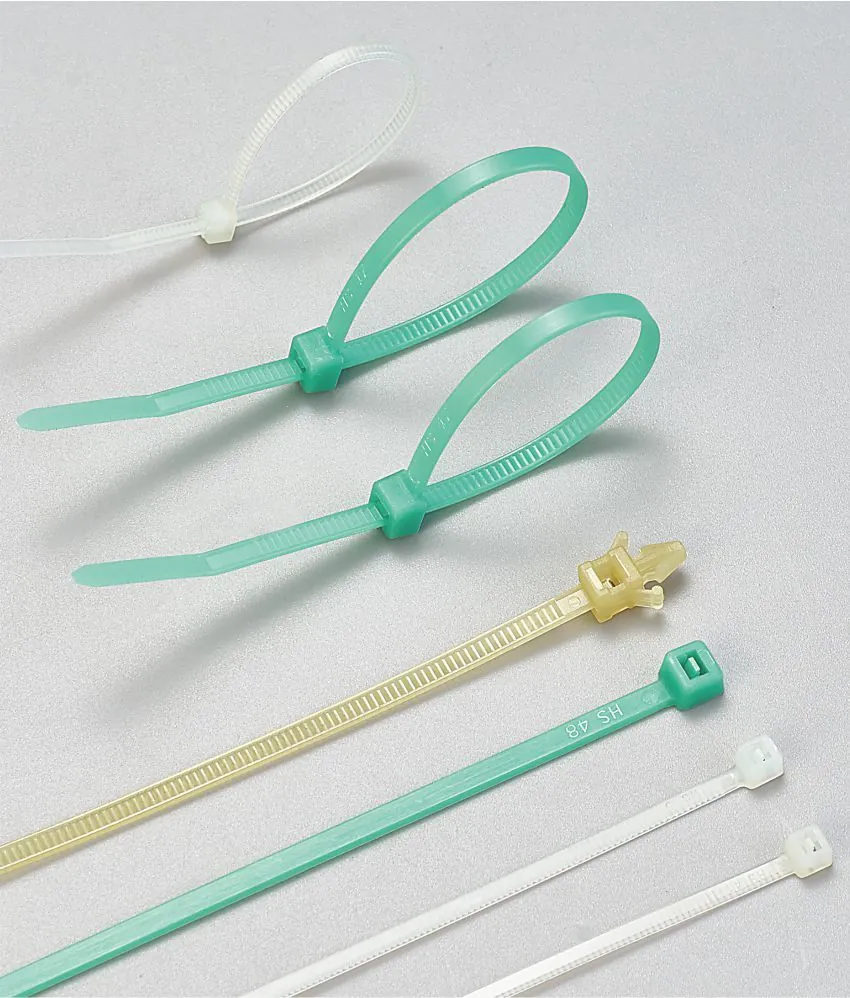
"High-temperature cable ties" is one of the most common — and most misunderstood — requests we receive. Many buyers use the phrase when they actually need one of two very different products: heat-stabilized ties that survive continuous heat, or flame-retardant ties that stop fire from spreading. The two are often confused, they are not interchangeable, and specifying the wrong one leads to field failures or failed safety audits. This guide explains exactly what each rating means, where each belongs, and how to write a specification that gets you the right product the first time.
The Confusion, in One Sentence
A heat-stabilized nylon tie is engineered to keep its strength at elevated temperature over years. A flame-retardant nylon tie is engineered to stop burning when a flame is removed. One is about long-term survival in a hot environment; the other is about fire behavior in an emergency. They answer different questions, and — this is the part that surprises most buyers — a V-0 flame-retardant tie is not necessarily rated for higher continuous temperature than a standard tie.
What "Heat Stabilized" Actually Means
Standard nylon 66 (PA66) performs well up to roughly +85°C continuous. Push it higher and the polymer slowly oxidizes and embrittles — the tie looks fine for months, then snaps under light load. Heat-stabilized grades add antioxidant packages that slow this degradation, extending useful life at elevated temperature. As a practical rule of thumb across the industry:
- Standard PA66: continuous service up to about +85°C.
- Heat-stabilized PA66: continuous service around +105°C to +110°C — the grade most OEMs specify for motors, transformers, LED drivers and appliance interiors.
- Extra heat-stabilized (PA46 or specialty grades): continuous service up to roughly +150°C for demanding underhood and industrial hot zones.
The key word is continuous. A heat-stabilized rating describes the temperature the tie can hold for the life of the assembly, not a short spike. If your application runs at +120°C for years, standard PA66 will eventually fail; a heat-stabilized grade is engineered for exactly that duty.
What "Flame Retardant" Actually Means
Flame retardancy is measured by flammability tests such as the UL 94 vertical burn classes. A V-0 rating means the material self-extinguishes quickly after the test flame is removed and does not drip flaming particles. Flame-retardant nylon is specified when the end product must pass a safety standard — appliances, power tools, public-transport interiors, electrical enclosures — where the cable tie is part of the flammability story.
Two points buyers routinely miss:
- V-0 is not a temperature rating. It tells you nothing about continuous operating temperature. Many V-0 compounds actually have lower long-term heat resistance than a good heat-stabilized grade, because the flame-retardant additives can accelerate aging at sustained high temperature.
- It is about the flame, not the heat. If a fire is hot enough and stays long enough, every plastic tie will burn. Flame-retardant grades are designed to self-extinguish in a small-flame scenario and to limit fire propagation — not to survive a furnace.
Heat Stabilized vs. Flame Retardant: Side by Side
Here is the comparison procurement engineers actually need when a "high temperature" request lands on their desk.
| Question | Heat-stabilized tie | Flame-retardant (V-0) tie |
|---|---|---|
| Primary job | Keep mechanical strength at continuous heat | Self-extinguish and limit fire spread |
| Continuous temperature | Up to ~+110°C (PA66 HS); ~+150°C (PA46/specialty) | Usually similar to or below standard PA66; not improved by V-0 |
| Fire behavior | Not necessarily flame rated | Self-extinguishing, UL 94 V-0 / V-2 classes |
| Typical driver | Hot operating environment (motors, engines, ovens) | Product safety certification (appliances, transport) |
| When it fails | Becomes brittle after months/years of heat | Burns if flame is sustained — but doesn't propagate |
| Color | Usually black or natural | Often off-white, black, or specialty colors |
And one line that saves a lot of confusion: if you need both continuous heat resistance and flame retardancy, say so explicitly — and confirm the supplier's grade covers both.
Which One Does Your Application Need?
Work through these questions in order:
- Is the tie exposed to sustained heat above +85°C? Yes → you need a heat-stabilized grade, not a standard tie. Near +150°C → step up to an extra heat-stabilized grade such as PA46.
- Is the environment merely warm (+60°C to +85°C) but stable? Standard PA66 is usually sufficient — don't pay for a grade you don't need.
- Does the end product require a flammability rating? Yes → specify the flame class (typically UL 94 V-0) in addition to any temperature requirement.
- Does the assembly sit inside a certified product AND near a heat source? Appliances with motors or transformers are the classic case — this is where you genuinely need both properties in one tie. Ask for a heat-stabilized flame-retardant grade and verify the data sheet shows both ratings.
- Are you in doubt about the actual ambient temperature? Measure it. "It gets pretty hot" is the leading cause of wrong specifications. A thermocouple reading over a full duty cycle settles the argument in an afternoon.
Common Specification Mistakes
- Writing "high temperature" without a number. +105°C and +150°C are different products. Always state continuous operating temperature and, if relevant, peak spikes and duration.
- Assuming V-0 means heat resistant. It doesn't — and the flame-retardant additives can reduce long-term heat performance. Check both columns of the data sheet.
- Assuming heat-stabilized means flame rated. A heat-stabilized grade may carry no flammability class at all. If the product needs UL 94 V-0, verify it.
- Testing only at room temperature. A tie that holds 30 kg at +25°C may hold far less at +100°C. Ask for tensile retention data at your operating temperature, not just the catalog value.
Where Each Fits in Our Range
If your checklist points to continuous heat, start with our heat-stabilized cable ties for the +105°C class, and step up to our PA46 extra heat-stabilized ties where duty approaches +150°C. If your product must pass a flammability test, our flame-retardant V-0 cable ties are engineered for appliance and transport safety requirements. Need both properties in one part — a motor-adjacent bundle inside a certified appliance, for example — tell us the temperature and the flammability class and we will point you to the grade that covers both, with samples to verify before you commit.
Still not sure which grade your project needs? Send us the operating temperature, the environment, and any safety standard the end product must meet — our engineers reply within 24 hours with a recommendation and free samples for testing.